
Insights
How the Grid Really Works
A clear guide to how electricity is made, moved & priced and why timing now shapes your energy bill.
Published Last updated
7 min readLast year, the UK paid wind farms over £800 million to switch off.
Why? Because the very power that keeps your lights on and your phone charged cannot sit still. Electricity has to be moved the moment it is generated or it simply disappears as heat. Large-scale storage exists, but it still plays a supporting role rather than the lead.
The system we rely on behaves less like traditional infrastructure and more like a real-time flow network, moving energy second by second with no buffer and no pause button.
We flick switches, plug in chargers and pay monthly bills. Yet few of us could describe how that power is made, moved and measured - or why it costs far more at six o’clock than at midday.
After a year working deep inside the energy world, I have come to see it as a product system that behaves nothing like the digital ones most of us are used to. Energy looks simple on the surface, but behind the socket sits a system that must constantly rebalance itself and is only now learning to respond to demand and price with the speed of modern software.
Why electricity behaves differently
People often say that all electrons are the same, and they are.
The one that boils your kettle is identical to the one charging your phone. What makes electricity complicated is not the product, but the chain of steps that brings it to you.
We do not create electrons, we set them in motion. A generator simply converts heat, movement or light into electrical flow.
Most of the UK’s power still begins in gas turbines. Burn gas, the hot gases expand, and the turbine spins. It works like a jet engine running on the spot, except instead of pushing an aircraft forward, the spinning shaft turns a generator.
We also generate electricity by splitting uranium atoms in nuclear plants, by letting water run through hydro turbines, or by turning wind and sunlight directly into current. However it is made, the output is identical. What changes is the cost and increasingly, the timing of production.
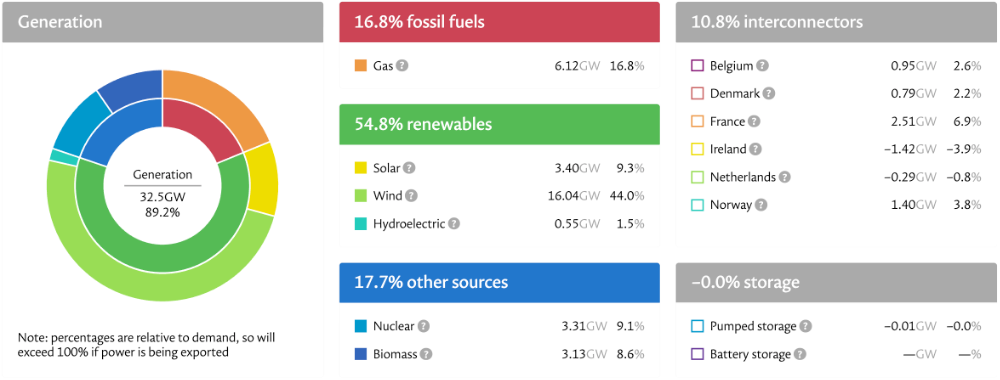
And unlike coal or oil, electricity itself cannot be stored directly in the grid. It has to move the instant it is created. Energy can be stored in other forms: water in a reservoir, heat in a system, charge in a battery. But these stores are still small compared with total demand. The grid’s job is to keep the flow moving so the lights stay on.
How electricity travels
Once electricity is generated, it enters the transmission network - the high-voltage motorways that move power around the country - before being stepped down through regional substations and delivered into homes and businesses at familiar 230-volt levels.
It is an extraordinary system: roughly 7% of all power is lost as heat along the way, yet it works with remarkable reliability. But like any road network, it has limits. Every transmission line has a physical capacity. Push too much power through it and the line overheats, which can damage equipment or force it to shut down.
When the network is full, no additional power can join the flow. In those moments, wind farms are paid to switch off - a practice known as curtailment. In 2023, curtailment cost the UK more than £800 million.
This is where prices start to move. Grid congestion works a lot like surge pricing: when demand spikes and the network has no spare capacity, scarcity pushes prices up.
To see what this actually looks like, here’s a typical day of UK electricity delivery costs - the price of using the grid itself, not the energy:
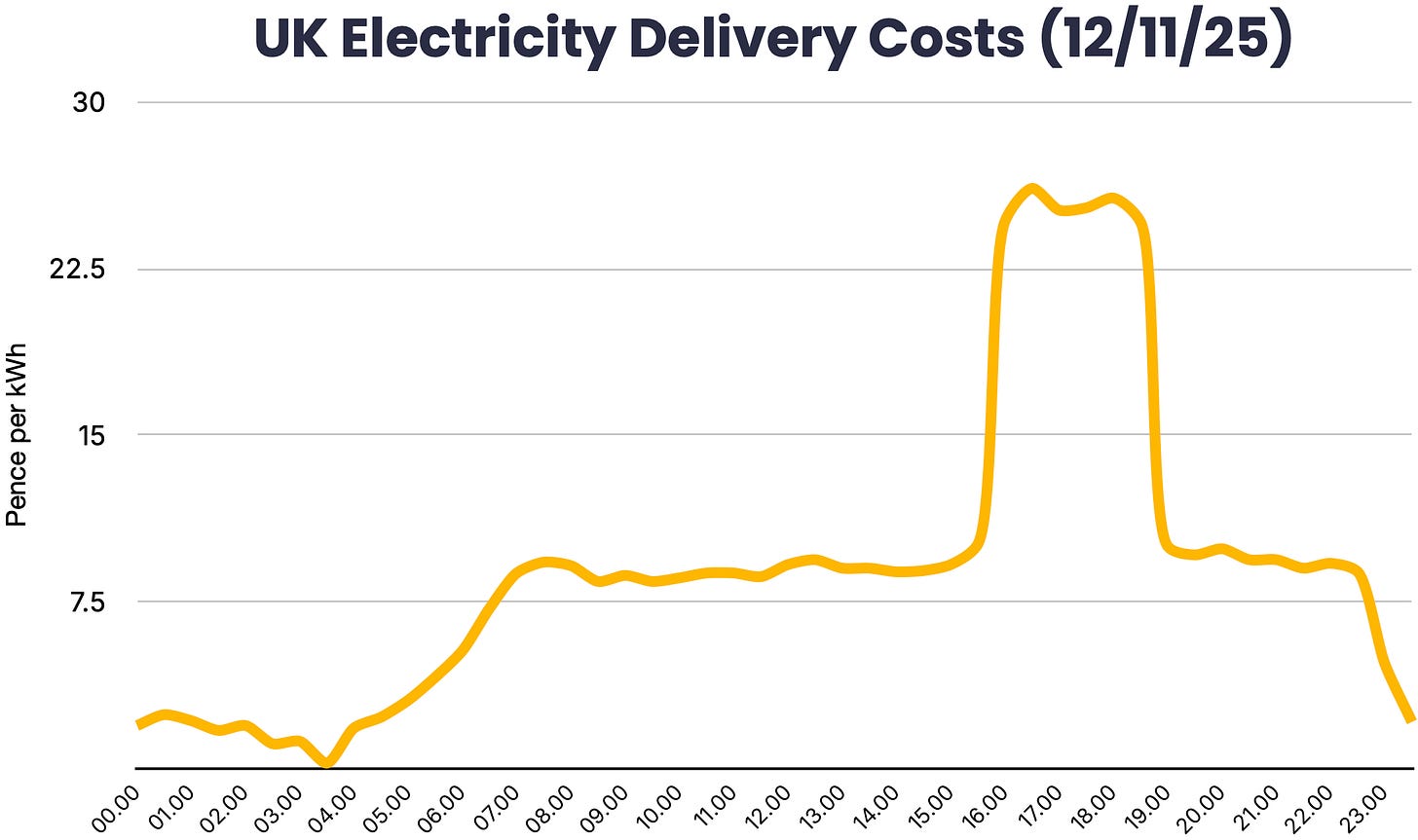
sample p/pkWh network use charges on a daily basis
The morning climb and the sharp evening peak aren’t random. They reflect how crowded the network is at different points in the day. When the system fills up, prices rise - and the same unit of electricity can cost pennies in one hour and pounds the next.
Buying time
Electricity is bought and sold in half-hourly blocks, forty-eight times a day.
The grid is divided into these thirty-minute windows because supply and demand must match in real time. There is no buffer, no storage tank and no pause button. Every half hour, suppliers have to prove they bought exactly the right amount of power for their customers.
When demand rises - everyone cooking dinner, kettles boiling, heating switching on, the price of that half-hour block climbs. When demand falls, or when there is plenty of wind overnight, prices drop. It is the same logic as surge pricing, applied to an entire national system.
Storage helps smooth these peaks. Pumped-hydro stations act like enormous water batteries, releasing power when the system is tight and refilling when it is cheap. Lithium-ion batteries are doing the same job at smaller scales. Increasingly, demand itself is flexible too. Factories, supermarkets and even households can be paid to shift their usage by as little as thirty minutes to help the grid stay balanced.
And this real-time approach is about to become the norm.
The UK’s upcoming Market-Wide Half-Hourly Settlement (MHHS) reforms will mean that every customer with a smart meter is settled every thirty minutes. Today, only about 30% of households are settled this way. MHHS will bring the whole market into the same real-time rhythm - making timing, not just volume, a central part of how electricity is bought, billed and valued.
Slowly, the energy system is learning how to buy time - by shifting demand, storing surplus and letting price signals keep the whole thing in sync.
Counting what matters
For decades, electricity billing ignored these dynamics. We paid flat rates - like paying the same for a train ticket no matter when you travelled.
Smart meters are changing that.
A smart meter records your usage every thirty minutes and sends that data to the national system run by the Data Communications Company. These readings feed the settlement process, which charges suppliers (and ultimately consumers) for what was used in each half-hour window, not averaged across the month.
This turns a monthly average into a living rhythm, a pulse running through the economy. It means you can save money not only by using less electricity, but by using it at smarter times.
And this shift is about to accelerate.
Under the upcoming MHHS reforms, every smart meter will move onto half-hourly settlement by default. Today, only a minority of households settle this way. MHHS will bring the entire market into the same real-time pattern of measurement, pricing and behaviour.
For businesses, this creates new design challenges: how to automate, schedule or store energy so that consumption aligns with cheaper periods. For suppliers, it demands products and interfaces that make this complexity feel simple.
From kilowatts to real-time orchestration
Once you start to see electricity as a real-time orchestration rather than a static product, everything else begins to make sense.
The grid must balance perfectly every second; supply has to equal demand. If usage rises in one part of the country, something else has to adjust instantly - more wind flowing south from Scotland, a battery discharging in Cornwall, or a cold store briefly turning its compressors down. Thousands of tiny actions, all nudged into place by sensors, software and price signals.
Carbon intensity follows the same rhythm. Ten years ago, each kilowatt-hour carried more than 500 grams of CO₂. Today it is closer to 150 and falling fast. As renewables grow, the variability of wind and solar means that timing becomes the next frontier: when the sun shines or the wind blows, electricity is abundant and clean; when it doesn’t, it becomes scarce and expensive.
That’s why when you use electricity is becoming just as important as how you use it.
A system we can redesign
The deeper you look, the more electricity resembles a system rather than a commodity - a continuous exchange between generation, networks and behaviour.
For past decades we optimised for production: build more generation, run it harder, keep up with demand.
The next decade will be about coordination: matching flexible demand with variable supply, guided by real-time data, automation and smarter pricing.
Energy does not manage itself. It is a system we built and one we are now rebuilding, cleaner, faster and fairer.
Once you stop seeing electricity as a bill and start seeing it as a living system, the opportunity becomes clear. The future is not only about producing more power. It is about using the power we have at the moment it creates the most value - for households, for businesses and for the grid itself.