
Operations
Commercial solar and battery
Why commercial solar and battery projects fail, why modelling must come before buying, and how to judge payback claims against your own meter data.
Published Last updated
The commercial solar and battery market has an incentive problem: almost everyone who models your project is also selling it. Sizing drifts towards what fits the roof and the budget, payback claims drift towards what closes the deal, and performance after commissioning is nobody’s job.
Model before you buy
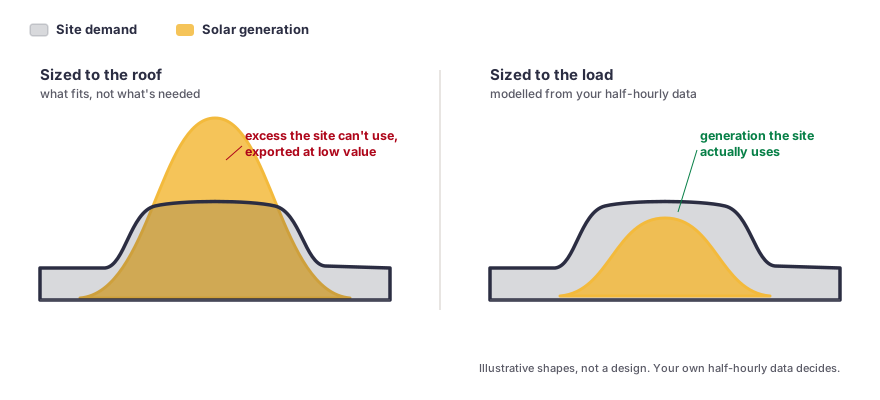
The only honest basis for a generation or storage decision is your own half-hourly consumption, modelled against realistic generation, tariff and degradation assumptions, by someone with nothing to gain from the answer. That is the discipline behind sizing and payback.
The order matters more than it sounds. Model, then buy. Reverse it, as most projects do, and the model becomes a justification for a system that has already been chosen. Assumptions bend towards the sale. Generation gets sized to the roof, because the roof is free space, not because the site can use what the roof produces.
A model built from your own half-hourly data answers a narrower and more useful question: how much of this generation will the site actually consume, at the moment it is generated? That is the number that decides the case. Power used on site displaces a retail rate. Power exported earns a fraction of it. A system that looks strong on annual totals can be weak once you see how little of it lands during the hours the site is drawing power.
Batteries widen the question rather than settle it. A battery can shift solar into the evening, avoid the most expensive network windows, and, on the right tariff, earn from the wholesale market. Whether those returns stack depends on the site’s profile and its tariff structure, which is why the battery case and the tariff case are really one case. Modelled together across one customer portfolio, a day-ahead tariff switch and battery deployment reached a combined payback of around 3.3 years. Modelled apart, neither figure means much.
None of this is knowable from a brochure. It is knowable from your data, read by someone who earns the same fee whatever the answer turns out to be.
The process is part of the project
Grid connection sits with your DNO and its G98/G99 process, and it can shape what you can build. See the DNO process. After commissioning, performance decays quietly unless someone owns it: see operations and maintenance.
Assets need an operator
A solar array or battery is not a purchase; it is an operating asset. Left alone, it underperforms its model. Run properly, it can earn beyond it. That is the Energy Operations argument applied to hardware, and it is why our Maximised tier exists.
If you are weighing a project, book a fixed-fee review before you sign anything. The fee is a fraction of the cost of a mis-sized system.
In this section
Sizing solar and battery systems
Why solar and battery systems should be sized from half-hourly consumption data, and how oversizing quietly destroys the business case.
The DNO process (G98/G99)
How grid connection approval works for commercial solar and batteries in the UK, and why G99 timing should shape your project plan.
Payback: how to judge the numbers
How to interrogate the payback figure in a solar or battery proposal, and the assumptions that quietly decide whether it is real.
Operations and maintenance
What operations and maintenance actually involves for commercial solar and batteries, and why unmonitored systems quietly underdeliver.
A solar array or battery is not a purchase. It is an operating asset, and left alone it underperforms its model.
Frequently asked questions
Is commercial solar worth it for my business?
It depends on one thing installers rarely model honestly: how much of the generation your site actually uses, at the times it is generated. A system sized against your real half-hourly consumption can be a strong investment; a system sized against your annual total usually is not. Model before you buy, with someone who does not profit from the sale.
Should my business install battery storage?
A battery earns in three ways: avoiding peak-rate consumption, increasing use of your own solar, and earning market revenue. Whether those stack up depends on your consumption profile, your tariff structure and your connection. The case must be built from your data, not from a vendor’s template.
Why do commercial solar projects fail?
The common failures are commercial, not technical: systems sized to the roof rather than the load, payback claims built on optimistic assumptions, no one accountable for performance after commissioning, and export left on a default rate. Each is avoidable with independent modelling and ownership after handover.