
Insights
The Energy We Don’t See
Why energy literacy begins with noticing what’s been hidden in plain sight
Published Last updated
6 min readWe have stopped noticing
A few years ago, my youngest daughter stood on a stage in a village hall and explained nurdles to a room of GPs. Tiny plastic pellets washing up on beaches, she said, had changed the way she noticed the world. Once she learned to see them, she couldn’t stop. She spoke plainly, without slides or statistics, describing how something small and familiar could alter how you look at everything else.
Afterwards, one of the GPs came over to me and said,
“She told us things we already knew, but somehow we never hear them.”
What struck me wasn’t a lack of knowledge. It was the absence of attention. The facts were already there, but they had slipped into the background, dulled by familiarity. No one had thought to hold them up to the light.
Energy sits in exactly the same place in our lives.
We use it constantly. We talk about it endlessly. We complain about the cost, worry about the future, and invest in new technologies. And yet most of us, even those running complex organisations, would struggle to explain how energy actually behaves across a single day. Ask a room of capable adults what they pay per kilowatt hour and the mood shifts. Someone guesses. Someone jokes. Someone says they should know this. The conversation moves on.
It isn’t apathy. Energy has become an acceptable blind spot.
Curiosity starts with discomfort
Part of the reason is structural. The energy system was never designed to be legible to the people at the end of it. Tariffs, settlement periods, standing charges and meter identifiers make perfect sense if you live inside the industry. For everyone else, they collapse into a monthly invoice. Ofgem’s own research reflects the result: most people can’t identify which tariff they’re on, even as energy has become one of the largest operating costs many businesses carry.
Every so often, though, something disturbs that comfortable blur.
A smart meter flashes a spike at a strange hour. Solar panels behave differently than expected. An EV costs half as much to charge one evening as the next. A home automation rule reveals that something you assumed was trivial is quietly drawing power all night. These moments don’t explain anything on their own, but they do something more important. They introduce friction. They create just enough discomfort to make curiosity unavoidable.
Energy stops feeling flat. Something about it no longer quite fits.
What our habits look like in daylight
If you want to understand what’s really going on, all you need is a single day laid out honestly.
Look at a half-hourly wholesale electricity price trace from a winter weekday. Overnight, the line sits low and steady. Early morning it begins to rise as homes and businesses wake up. Through the middle of the day it plateaus, reassuringly. Then, as people head home and demand surges, the price steepens sharply. By early evening it peaks, often dramatically, before falling again later at night.
Nothing about this is surprising once you see it. And yet most organisations behave as if it doesn’t exist.
Across a single day, the price of electricity can easily double or triple between its cheapest and most expensive half-hours.
The same unit of energy, delivered through the same wire, costs radically different amounts depending on when it’s used.
This isn’t an edge case. It’s the basic rhythm of the system.
What the graph really shows isn’t the market. It shows us. Our routines. Our assumptions. Our automatic behaviours, laid out in daylight.
And once you’ve seen that, it’s impossible to unsee it.
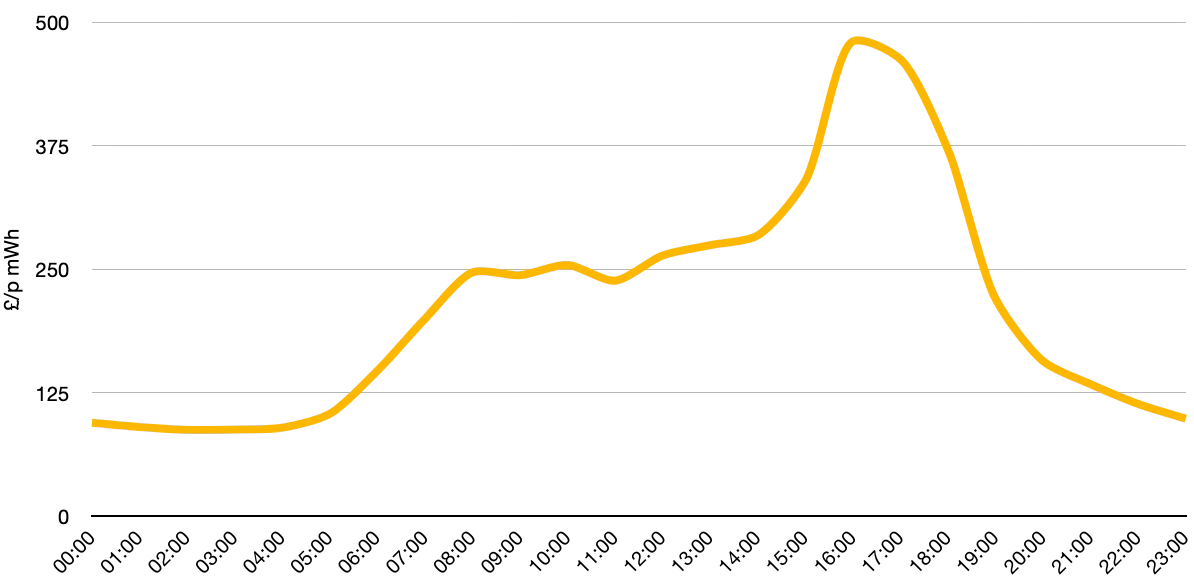
Wholesale Half-hourly day-ahead electricity prices, UK - 12 December 2024
Why work is darker than home
At home, this kind of visibility changes behaviour quickly. People shift EV charging. They delay dishwashers. They begin to care about timing because timing now has meaning. The feedback loop is short, and the consequences are tangible.
At work, that loop is almost always broken.
Most people don’t see how their building behaves across the day. They don’t know when energy is cheap or expensive. They don’t see the early-morning ramp-up, the lunchtime lull, or the evening spike. Responsibility is fragmented across finance, facilities, procurement and sustainability, each holding a fragment of the picture but rarely the whole.
This creates a quiet contradiction inside many organisations. The same person who times their EV charging at home walks into an office where no one can explain why the building costs more to run at 5pm than at 11pm. It’s not that they’ve lost their instincts. It’s that the light has been turned off.
The people who refuse not to see
Some people notice anyway.
They spot lights burning long after everyone has left. They question why heating ramps up hours before the first meeting. They ask why energy costs spike at predictable times without anyone acting on it. They are not specialists. They are simply paying attention. They are willing to look into corners most organisations leave in shadow.
Others adapt to the darkness. They assume energy is fixed, that complexity means “don’t touch”, and that attention is better spent elsewhere. Their disengagement isn’t indifference; it’s learned behaviour in a system that doesn’t reward looking closely.
Most organisations contain both. The difference between them isn’t intelligence or seniority. It’s whether they believe the system is worth seeing.
When the system forces us to pay attention
Change usually begins when something makes invisibility impossible. EV chargers make timing unavoidable. Carbon targets demand baselines. Smart building systems reveal behaviour no one expected. Solar exposes the relationship between generation and demand.
These moments don’t feel like strategy at first. They feel like inconvenience. But they all have one effect in common: they force attention.
Energy literacy is often described as technical expertise, but in practice it’s much simpler.
It’s the ability to see how your organisation actually uses energy, clearly enough to make better decisions than yesterday.
When do we consume the most? Why does the spike happen when it does? Which behaviours matter, and which don’t? Where is cost driven by habit rather than necessity?
Once those questions become answerable, behaviour shifts quickly. Flexible tariffs stop feeling risky because their interaction with demand is visible. Solar and batteries stop being abstract investments and become tools for shaping a curve you now recognise. Carbon reduction moves from aspiration to arithmetic.
Turning the light on
Most energy transformations begin this way. Not with hardware and not with policy, but with visibility. Someone sees the system clearly for the first time and realises the organisation has been acting blind. A conversation changes. A meeting goes differently. A decision that once felt marginal suddenly feels obvious.
Which brings me back to that village hall. My daughter didn’t teach those GPs anything new about nurdles. She simply made something visible again. She took a detail that had faded into the background and put it back under the light. Once she did, it changed how they looked at the world.
Energy works the same way. We don’t lack solutions. We lack sight. And the moment people can finally see how energy behaves - not in theory, but in their own lives and buildings - everything else follows.
Energy doesn’t transform when the technology arrives.
It transforms when someone finally turns the light on.