
Insights
The Grid Is Britain’s Real Infrastructure Crisis
We can build homes, data centres, and solar farms in months. We still take years to power them. The grid queue shows what happens when ambition outruns the system beneath it.
Published Last updated
6 min readA Housebuilder in the Cold
Last week I met a national housebuilder preparing a thousand-home development. The plans were complete, the land secured, and the finances arranged. Local government was supportive. On paper, construction could begin almost immediately.
Then the Distribution Network Operator told them the grid connection would take more than ten years.
It was delivered without urgency. A kind of “computer says no” culture has settled into parts of the system. Instead of a conversation about options, sequencing, or reshaping an application to accelerate a date, developers receive a single number placed so far into the future that it barely counts as information.
It revealed something essential about Britain’s energy transition. The investment story feels warm. The lived experience of trying to build anything physical still feels cold.
Warm Headlines, Cold Machinery
From a distance, Britain looks as if it is finally mobilising. Regulators are approving large investment packages. Funds are pouring into batteries, data centres, and industrial electrification. Public bodies talk confidently about corridors, clusters, and modernised grids.
This week’s announcement of twenty-eight billion pounds of network investment is only the first part of a programme expected to exceed ninety billion by 2031. For comparison, the total between 2021 and 2026 was around thirty-five billion. The ambition has almost doubled.
The harder question is whether the industry has the capacity to deploy capital at that pace.
Zoom in, and the picture cools. Projects drift. Timelines stretch. Sites with planning, land, and capital wait in line as if they were asking for something unusual. The machinery that turns ambition into delivery has not yet warmed.
Nowhere is this clearer than in the queue for grid connections.
The Queue That Reveals the System
A few years ago, the list of projects waiting to connect sat just above two hundred gigawatts. Today it is above seven hundred. Britain’s peak electricity demand is around fifty-eight gigawatts. The queue now dwarfs the system it hopes to join.
Most of these projects will not be built, yet they still fill the pipeline. They hold capacity that others need and push viable schemes into the late 2030s. A queue is meant to show order. This one shows strain. It reveals a system being asked to carry more than its foundations allow.
The direction of travel becomes clearer when you see it over time.
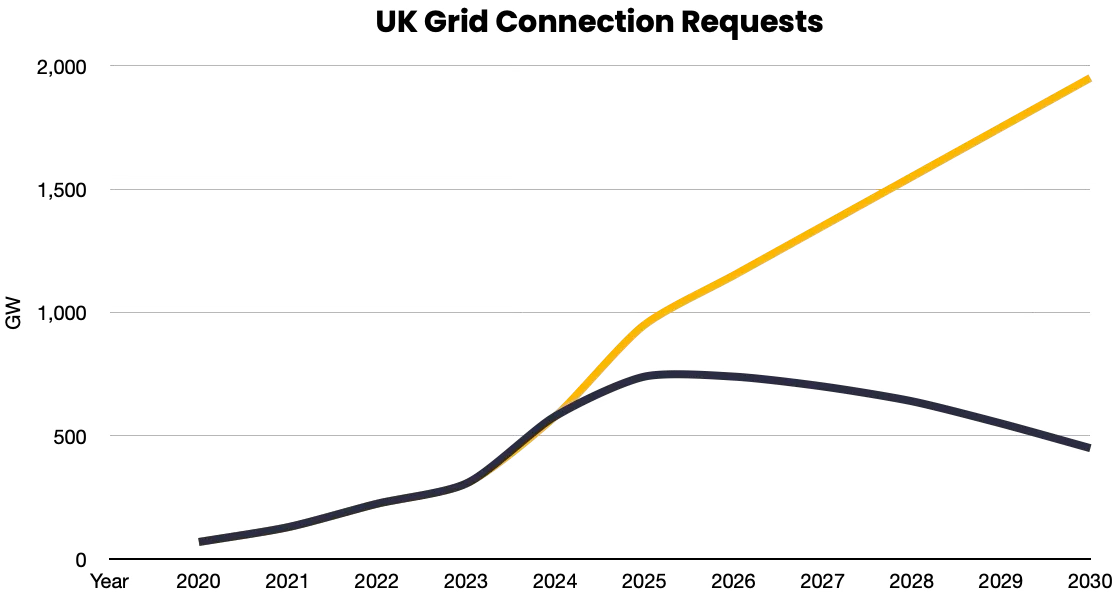
The picture is no longer just about scale. It is about trajectory. The blue line shows the government’s attempt to bring order to the queue, to sift out speculative projects and prioritise the ones that can genuinely be built. The yellow line shows the alternative. If reforms fail to take hold, applications will keep rising and the gap between demand and capacity will widen. One curve bends downwards. The other keeps climbing. The system is sitting at the fork.
What matters is not only the size of the queue but the shape of it. If the government succeeds, the queue begins to resemble something a modern grid can manage. If it falters, the backlog will grow faster than the system can process it, pushing credible projects deeper into the future. Execution, not aspiration, will determine which line we follow.
The Machinery Beneath the Numbers
The deeper challenge is not financial. It is cultural.
Britain has lived for decades inside the comfort of an inheritance. Victorian engineers built water networks that still serve us. Post-war planners built a grid that powered the rise of the modern economy. These were confident acts, created by people who believed infrastructure could shape society.
Over time that confidence faded. We learned to maintain rather than build. The grid still carries assumptions from an era when coal set the rhythm of the system. Planning rules still reflect a fear of overbuilding rather than a need to meet rising demand.
This creates a peculiar illusion. Headlines suggest momentum. The underlying machinery remains cold.
A False Spring
The energy transition is experiencing a kind of false spring. The air has started to warm, yet the soil remains frozen. Nothing grows until the soil thaws.
Capital moves quickly. Institutions do not. A data centre can raise funding in days. Securing the capacity to energise it may take years. A solar developer can plan a site in months. Connecting it to the grid can take a decade.
Optimism becomes fragile when the pace of investment outruns the pace of adaptation.
The Real Constraint: Imagination & Competence
It is tempting to assume the bottleneck is funding, technology, or political appetite. But the more durable constraint is imagination, and something quieter: capability.
The state has spent decades optimising for caution, reducing budgets, and trimming long-term programmes. It has forgotten how to operate under conditions of growth. HS2 is only the most visible example of what happens when ambition outpaces the institutions meant to deliver it.
We talk about infrastructure as if it were a spreadsheet. The people who built the systems we rely on today treated it as a public project, a way of expanding what society could do.
Rediscovering that mindset does not require sweeping rhetoric. It asks for institutions that can learn. Systems designed for change rather than permanence. Shared data that allows decisions to move at the pace of evidence instead of paperwork. A willingness to update assumptions that no longer hold.
Good infrastructure is not a monument. It is something closer to a garden. It grows, adapts, and needs care.
Turning Capital Into Capability
Turning investment into capability is patient work. It asks governments to act as catalysts, not clients. It asks investors to value delivery rather than declarations. And it asks designers and engineers to build systems that can adapt rather than stand still.
Every substation upgrade, every kilometre of cable, every new connection is an opportunity to rebuild the physical backbone of the country. But time is not patient. The climate will not wait for administrative reform. Nor will the industries trying to electrify.
Britain has the capital and the technology. What it needs now is the imagination and the competence to redesign the systems beneath the surface. If the thaw does not reach our institutions, the spring will pass before anything meaningful begins to grow.
Which brings me back to the housebuilder. A system that can build a home in months but takes a decade to switch it on is not suffering from a lack of investment. It is suffering from a lack of something deeper.
The thaw will be real when a decade-long wait for electricity feels like a story from another age.