
Time-of-use tariffs for commercial sites
How time-of-use tariffs work for UK commercial sites, which load profiles they suit, and how to test the fit before committing.
Last updated
Time-of-use tariffs price electricity according to when it is consumed. The underlying cost of power varies constantly, and time-banded network charges vary with it, so a time-of-use structure passes some of that shape through to the buyer instead of averaging it away. For a commercial site, the question is never whether time-of-use tariffs are good. It is whether your load shape and this pricing shape fit each other.
Most businesses cannot answer that question, because most businesses have never seen their own half-hourly data. Tariff structure gets chosen by habit or by whichever quote is presented, and the result is a market full of sites on structures that do not match how they use energy. The mismatch is a direct and avoidable cost, and it is invisible on a quote comparison.
How the fit works
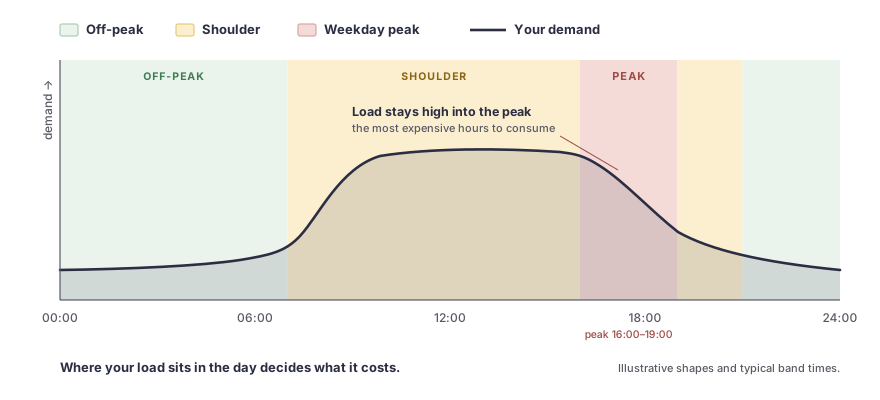
A time-of-use tariff rewards consumption that sits in cheap periods and penalises consumption in expensive ones, with the evening peak the most expensive territory on both wholesale and network components. Sites with daytime-weighted load, overnight processes, or genuine flexibility in when they run equipment tend to fit well. Sites whose demand peaks exactly when the system peaks fit badly, and for them a flat structure may genuinely be the better buy. Neither conclusion is available without the data.
A cold store running the same load at three in the morning as at three in the afternoon sits badly on a time-of-use structure, because none of its consumption can move to the cheap hours and all of it is exposed when the expensive band arrives. A bakery or a distribution site with genuine overnight operation sits well, because the hours it already runs are the hours the structure rewards. An office with a flexible plant room, one that can pre-cool or pre-heat a building ahead of the peak rather than during it, can turn a small operational change into a real reduction in exposure. A site with on-site generation shifts the picture further, because self-consumption during the day reduces exposure to the most expensive evening band before the tariff structure even comes into play. The test is the same in every case: does the load move, or is it fixed to the clock regardless of price.
The averaging cost of staying flat
A supplier offering a flat rate must cover the risk that your consumption is expensive in shape. That risk premium is embedded in the rate whether your shape is expensive or not. Businesses with favourable profiles pay it anyway, which means the businesses best placed to benefit from time-of-use pricing are often the ones paying most for not having it.
That premium is not disclosed as a line item, so it is easy to assume it does not exist. It is priced into the flat rate itself, set across a supplier’s whole book of customers rather than any individual site, which means a business with a genuinely favourable, low-cost shape is charged the same premium as one with the most expensive shape on the supplier’s books. A favourable-shape site on a flat rate is, in effect, buying insurance it does not need. The only way to find out how much that insurance costs is to price the site’s own half-hourly load against the alternatives.
One multi-site operator did exactly that. Modelling its portfolio against a day-ahead pass-through structure showed a saving of £86,779 a year, a 12.0% reduction in commodity cost, achieved without any capital spent. The same exercise, run against a second site in the same portfolio, closed the idea rather than confirming it, because that site’s existing contracted rate already beat spot pricing. Same test, same portfolio, two different answers. Fit is a property of the site’s data, not a universal rule, and a result of no change is as valid an outcome of the test as a saving is.
Testing before committing
The test is retrospective modelling: price a full year of your half-hourly consumption under each candidate structure, including the network charge treatment, and compare totals. A full year matters because seasonal shape can reverse a conclusion drawn from a single quarter. The output is not a forecast of the market. It is a clean statement of which structure fits your shape, which is the decision actually in your control.
Time-of-use is also where operational changes start paying: once time carries a price, shifting load becomes a financial lever rather than a good intention.
To find out whether your current structure fits your consumption, request a benchmark at /benchmark or book a review at /book.
Part of Commercial energy tariffs .
Frequently asked questions
What is a time-of-use tariff for a business?
A tariff where the unit rate varies by when you consume: by time of day, day of week, or season. Instead of one flat rate, you pay less in cheap periods and more in expensive ones, reflecting how the underlying cost of electricity actually behaves. Whether that helps or hurts depends entirely on your load profile.
Is a flat rate safer than a time-of-use tariff?
A flat rate is not the absence of time-of-use pricing; it is time-of-use pricing averaged by the supplier, with the averaging risk priced in. If your consumption is skewed towards cheap periods, a flat rate quietly overcharges you for a shape you do not have. Flat feels safe because it is simple, but simplicity and value are different properties.
How do I know if a time-of-use tariff would suit my site?
Model it. Take a year of your half-hourly data and price it under the candidate structure alongside your current one. The comparison shows what each would actually have cost for your real consumption, rather than for an assumed profile. If a supplier or broker recommends a structure without asking for your interval data, they are guessing.